|
Public Dynamics: Public speaking skill coaching and presentation skills training in a fun and dynamic format.
San Diego public speaking skills training with professional motivational speaker Milo Shapiro.
Keynote speeches on public speaking and presentation skills by speaking coach Milo Shapiro via www.PublicDynamics.com.
A fun and interactive way to improv your speaking skills with San Diego speech coach Milo Shapiro.
Coaching in presentation skills and public speaking skills available.
Centrally located to serve downtown, North County, East County, South Bay, La Jolla, Chula Vista, Del Mar, and more.
Public speaking help with presentation skills training in a fun and dynamic format.
San Diego executive speaking coach Milo Shapiro will make your program more powerful and captivating.
The San Diego public speaking coach who will bring out your personal best while giving you solid fundamentals to draw from.
Public speaking skills and presentation skills training in a fun and dynamic format.
Los Angeles public speaking skills training with professional motivational speaker Milo Shapiro.
A fun and interactive way to improv your speaking skills.
Coaching in presentation skills and public speaking skills available.
Keynote speeches on presentation skills and public speaking by speaking coach Milo Shapiro via www.PublicDynamics.com.
Public speaking skills and presentation skills training in a fun and dynamic format.
California public speaking skills training with professional motivational speaker Milo Shapiro.
A fun and interactive way to improv your speaking skills.
Coaching in presentation skills and public speaking skills available.
Work on your fear of speaking in public with San Diego speaking coach Milo Shapiro.
Get a San Diego speech coach to make you more dynamic, relaxed, and effective.
San Diego speaking coach Milo Shapiro eases the fear of speaking with fun exercises and valuable feedback.
Work on your stage fright with a speech coach like Milo Shapiro so you'll be confident.
Public Dynamics: San Diego speech coach Milo Shapiro eases the fear of speaking with fun exercises and valuable feedback.
Public speech and presentation skills training in a fun and dynamic format.
San Diego public speech skill training with professional motivational speaker Milo Shapiro.
A fun and interactive way to improv your speech skills.
Coaching in presentation skills and public speech skills available.
Public speech skills and presentation skills training in a fun and dynamic format.
San Diego executive speech coach Milo Shapiro will make your program more powerful and captivating.
Los Angeles public speech skills training with professional motivational speaker Milo Shapiro.
A fun and interactive way to improv your speech skills.
Coaching in presentation skills and public speech skills available.
Public speech skills and presentation skills training in a fun and dynamic format.
California public speech skills training with professional motivational speaker Milo Shapiro.
A fun and interactive way to improv your speech skills.
Coaching in presentation skills and public speech skills available.
Work on your fear of speaking in public with San Diego speech coach Milo Shapiro.
Get a San Diego speech coach to make you more dynamic, relaxed, and effective.
Work on your stage fright with a speech coach like Milo Shapiro so you'll be confident.
Milo Shapiro is also a motivational public speaker with presentations on risk-taking and on public speaking skills.
|
|

|
 |
Milo Shapiro
Speaking Coach
Powerful Communication:
Giving Your Words
Impact
Speech coaching
and classes
for anyone who needs
to speak
in front of groups of any size.
|
 Contact Page for Speech Coaching
 |
|
|
|
|
|
  |
|
|
Full Speech Ahead!™
Public Speaking Coach
Milo Shapiro's column on the
art and business of public speaking
If you reached this column from a
web search, you might want to start at the
column menu.
If you'd like to comment on the
columns or contact me about usage, please use the contact links
from this site.
|
Column #2:
Vocal variety, part 1
 |
|
Q: I've been told that I ought to use more vocal
variety, but this doesn’t come naturally to me. What
can I do?
− W.L., Tierrasanta, CA |
Having good vocal variety
and using it in the right places in your program can make all
the difference between being big news and being a big snooze.
When I’m coaching, I encourage the use of what I call
the Seven Variants of Vocal
Variety™. These are simple
things that one can work on varying to make a moment in your
program different from the one it follows. Some might be
incorporated into the same sentence while others might be a
whole section done a certain way, especially if you’re creating
a character to differentiate individual speakers in a story.
Here are the seven points, from simplest to those
requiring more practice:
1)
Volume. It may sound
simple but some people don’t vary this factor. I don’t
want you screaming at your audience or making them strain to
hear you, but boosting volume can point out passion for a word
or phrase vs. lowering volume to convey softness and ease on a
topic.
2)
Pitch. Singing is not the
only place that pitch is important and with speaking, you don’t
even have to be “on pitch”. You just have to vary it.
Whether you tend to have a high- or low-pitched voice, you are
capable of going higher and lower than you typically do.
Try saying the following phrase all in the same pitch and then
again saying the italicized words at a somewhat higher pitch:
“We
don’t sell like that and I can’t imagine why we’d
want to!”
See how that sentence
sounds more lively that way? I'd be you increased your
volume a bit as well, which is fine…unless you’re reading this
in a cubicle…
3)
Speed. Some of us
naturally speak faster than others and that’s okay, so long as
you’re not losing the audience members who might not keep up.
Yet too slow…and some attendees, especially younger ones, will
lose interest. The key again? Variety.
Let’s try saying this example all at one speed and then again
picking up the pace of the italicized portion:
“The key to customer loyalty − and this is especially
true with women − is to show you’re really
listening.”
If your pitch went up in the middle too, good for you! Why is
this effective? Because the return to the slow-down for that
last phrase now seems more significant.
There’s so
much to say on vocal variety that I'll save the
other four points for our next column.
|
|
A favorite coaching testimonial:
 Testimonial from
Dr.
John Jenrette, Testimonial from
Dr.
John Jenrette,
CEO,
Sharp Community Medical Group
"I’ve participated in many programs on speaking skills over
the years, but this was my first time trying individual
executive coaching on the topic − and what a difference!
Your working directly with me advanced my knowledge and
abilities to a level that group lessons never could.
"The one-on-one
approach allowed you to focus solely in areas where I needed
development as a CEO speaking to my organization. Together,
we determined areas in which growth would benefit me and you
tailored exercises directly relevant to programs that I
give, setting that growth in motion.
"The most definitive
moments of payoff were after you worked with me on specific
upcoming programs. Your ability to help me find more
powerful words, streamline my ideas more effectively, build
stories with strong imagery, and communicate the final
speech in a dynamic style is making an impact on my
audiences. After my presentation this week, I had two
doctors came up to me and tell me how much they enjoyed my
presentation. Doctors! A tough bunch to impress!
"I had confided
in a colleague that I'd hired a coach. The day after the
presentation, he approached me to say he’s seen a noticeable
improvement in the quality of both my material and
performance. He also said he could see that audience’s
attention was decidedly stronger than in the past. "
(Please click to see the whole letter from Mr.
Jenrette)
Here's an email from Dr.
Jenrette six months later:
|
Milo,
I am getting great
feedback
at my most recent talks
and lots of questions on how I did this.
Today I presented at the Sharp Leadership
conference to tell people how I was a “Learning
Leader". I told the story of how I wanted to improve
my presentation skills and how I hired a speaking coach
with improv skills and
demonstrated some of what I learned and gave a
hugely successful presentation.
Mike Murphy, the CEO
of Sharp HealthCare, told me
there are going to be lots of people who want to
find out who I worked with and there were lots of
congratulations afterward.
Our
Director of the Six
Sigma team here at Sharp HealthCare
texted me (during the meeting!) and he has been
looking for a way to improve his team of black belts
on presentation skills, facilitating their work
groups, etc., but he had not found anything very
innovative. He and I talked after the meeting and
you'll be hearing from him soon!
Thanks again, Milo and I have a feeling there will
be more interest coming from Sharp.
Happy to let you know that we're already working on
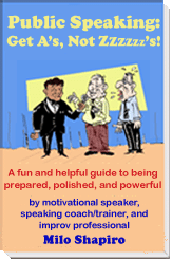
bringing you in to give your keynote "Public
Speaking: Get A's, Not Zzzzzz's!" for a larger group
so we can gauge interest in more coaching around
Sharp. Hope you have time in December for
that.
John E. Jenrette MD
John E. Jenrette MD
Chief Executive & Medical Officer
Sharp Community Medical Group |
|
|
|
Coaching Praised by:
See more clients WITH their comments
|
|
|
|